|
Ask people about a trust fundraiser's most important skills and I bet these would be common answers:
These are all vital, but I've got an underrated one to add to the list: the ability to ask the right questions. The trouble with the art of ‘writing convincingly’ is that it can be misunderstood as ‘papering over the cracks to make sure we've got a good chance of succeeding’. As a trusts fundraiser, have you ever been guilty of the following:
 Writing convincingly doesn't mean papering over the cracks in your project Many organisations approach us for fundraising support to help make their jobs easier. And in many ways, we try to be easy to work with: we plan ahead to allow time for deadlines, we condense funding guidelines into a few key bullet points, we'll sift through dense background reading to find a few key points for an application. But you know what - sometimes we’re a bit of a pain to work with, and I wouldn’t have it any other way. It’s easy to keep people happy, pretend you’ve got everything you need for a strong application and submit it as quickly as possible. Initially, everyone will feel great. Then when the funder comes back and says no, suddenly everybody is a lot less happy. That's why it's important to avoid papering over the cracks and be prepared to ask the difficult questions:
This isn't about voicing your personal concerns. It's about trying to really get under the skin of the funder and anticipating what they'll think when reading your application. What will they be looking out for as proof that you know your stuff? What aspects might they be concerned about, given their own funding priorities? Will they understand all the language you've used if they don’t have specialist knowledge of the subject?  Reviewing your draft applications critically - and from the funder's perspective - is crucial Sometimes this means having a certain amount of distance from the cause is a good thing. Our clients often tell us that they chose to work with us because we're knowledgeable and passionate about their work. I agree this can be a good thing, particularly when approaching specialist funders, but it's also risky to know far more about a subject than the person who’s going to be reading your work, or so convinced about a project that you lose the ability to critique it objectively. All that said, when you’re working with people who are super busy and a funding deadline is looming, I appreciate that digging your heels in and asking difficult questions won’t always make you popular. But ask yourself this - would you rather have a difficult conversation during the drafting process when there's still time to address something, even if people think you're being too cautious? Or deal with the disappointment later when an application is rejected and you're powerless to fix it? I’d always rather trust my judgement and stick to my guns on a point that could be crucial to the funder, than regret having backed down later. People do usually appreciate this in the long run. We've had plenty of tricky conversations with clients when working on a major application, but they frequently tell us later that it was worth going through the pain to make it stronger.  Sometimes a heated conversation is worth it to strengthen your application That's not to say you'll always get your way - we all get overruled sometimes, and have to back down or at least pick our battles. The important thing to remember is that your job is to ask the right questions, not to provide all the answers.
So here's my challenge to all the trusts fundraisers out there: be bold, be prepared to ask the difficult questions, and don't think you're doing your organisation a favour by papering over the cracks. If your colleagues think you’re always a dream to work with, perhaps you're not raising as much money as you could... And if this leads to the odd difficult conversation internally, then by all means blame us and point people towards this blog!
2 Comments
With rising levels of social need and ever-increasing competition for grants, the National Lottery Community Fund remains one of the few bright spots of hope in the UK funding landscape for many charities. While the £600million+ they give away each year through various programmes is a lifeline for many organisations, some are put off applying because of the time required to understand the different programmes and funding criteria, concern about the level of competition, or not being sure that they’re eligible. We’ve helped charities to secure over £1million of Lottery funding in recent years, and have developed a good understanding of what Lottery are looking for, and how to emphasise key strengths and address weaknesses in your application. And since many community-based organisations need stable multi-year funding more than ever before, we wanted to share a few tips: 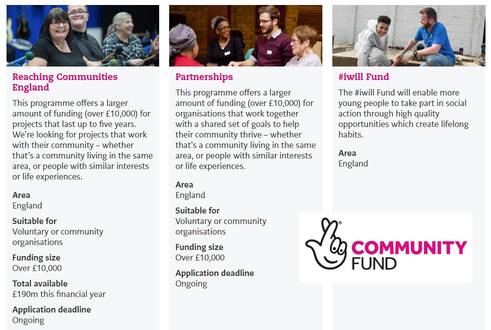 The National Lottery Community Fund gives away over £600million per year, with various active funding programmes at any one time Think laterally about the definition of a ‘community’A common misconception is that when Lottery say they provide funding to ‘communities’, they only mean physical, geographical communities. This isn’t the case, because Lottery can and do fund organisations supporting communities of interest, which they define as ‘people with similar interests or life experiences’. We recently worked with The PKD Charity to secure Reaching Communities funding for their programme of face-to-face, online and telephone support for patients and families affected by polycystic kidney disease. The people they support live all around the UK, and some rarely if ever physically meet up with others. However, feedback from beneficiaries and charity staff emphasised that people forge important relationships through the charity’s social media support groups, telephone befriending or periodic meet-ups – and that these relationships help them to overcome challenges and live more fulfilled lives. That’s the true definition of a community – and it was a community that relied to stable funding to flourish. If your organisation works with people united by certain interests or challenges, rather than a geographical location, then you may well be eligible for Lottery funding if you can make a similar case for support. Demonstrate that your community values your service and has been involved in designing itThis is arguably the most important criteria for many Lottery funding programmes. You need to show that your services are genuinely based on people’s ideas, aspirations and unmet needs, not just dreamed up in a boardroom somewhere. This can be difficult to demonstrate, particularly if it feels like second nature. For example, if you run a local community centre, your frontline staff will interact with service users on a daily basis, and naturally develop activities in response to their ideas and needs. As we’ve written before, you still need explain and provide examples of how this happens, as well as detailing more formal consultation methods, such as surveys and focus groups. Working with The PKD Charity, we had an unfair advantage – they’d actually commissioned us previously to run a stakeholder consultation exercise, which involved surveying hundreds of patients on their needs and opinions about the charity’s support, and interviewing prominent medical professionals. This type of exercise takes time and money, but is hugely beneficial for Lottery applications – and indeed for other funders. So don't hold back from including your consultation data in your application.  Showing that your community values your project and has been involved in designing it is crucial for Lottery funding applications Bring your application to life with a range of mediaA strong funding application doesn’t just rely on written words. Images and video bring your work to life, inspire empathy, and allow people to tell their story in their own words. This again helps to demonstrate community support and involvement in your project. Audio clips are an underused tool for people who have a story to tell but don’t feel comfortable talking in front of a camera. And diagrams and infographics can often explain something succinctly that'd otherwise need a few hundred words. Lottery encourage and appreciate the use of imagery, audio and video. For some funding programmes, you can actually by video rather than in writing. And you can really bring a detailed second-stage funding proposal to life by including things like infographics, embedded audio clips and video links. Explain what other services exist for your community, and their limitationsLike many funders, Lottery are anxious to avoid duplication – in other words, funding multiple organisations to deliver overlapping services. This doesn’t mean that your work needs to be 100% unique – and claiming that it is may show that you haven’t researched your project well enough. However, you should explain why other services aren’t accessible to the people you support, or appropriate for their needs. For example, when we secured funding for a youth employability charity, we provided evidence that young people were put off accessing other local services because they didn’t have an opportunity to build a trusting relationship with the service providers, and because of the complexities of local gang rivalry and ‘territory’. In another successful application, we showed how people with a learning disability weren't benefitting from mainstream health and wellbeing activities, because they needed extra time and support to address their complex needs. This is a way to both demonstrate an in-depth understanding of your sector, and provide further evidence that your services are based around people’s needs and views. Always seek and clarify feedback from your Funding OfficerWhile Lottery ask for a lot of detail for their larger funding programmes, they’ll also provide feedback along the way – particularly if you ask the right questions. If you apply to Reaching Communities, you might receive initial written feedback on areas to strengthen and clarify, an opportunity to discuss your idea by phone with a Funding Officer, detailed guidance on what to then include in a full proposal, and even an opportunity to get a draft reviewed before submitting.  Take every opportunity to speak to your Funding Officer and make the most of their feedback Receiving feedback and even criticism about your work can feel uncomfortable, but embracing this scrutiny will improve your chances of securing funding. Take every opportunity to clarify feedback that you don’t understand, and pro-actively check that you’ve explained any complexities in your project clearly.
For example, for a recent application that we supported, the Funding Officer expressed concern about the financial sustainability of the project. This was something we felt had already been addressed adequately – but by drawing their attention to what we’d written already and asking what they felt was unclear or missing, we were able to drill down into exactly what the assessment panel was looking for, and how best to provide it. We’re confident that following these tips will increase your chances of securing Lottery funding, and indeed other grants too. Feel free to suggest any further tips in the comments below. Good luck with your application, and take a look at how we could potentially help you with funding applications. We often get asked by charities and social enterprises for advice on how they can raise more unrestricted funding from trusts and foundations. Many organisations are very successful at securing grant income, yet still find themselves in a tight financial position because the majority of funding tends to be restricted to a specific purpose. While project funding is vital, it rarely gives you the flexibility you need to thrive as a resilient and innovative organisation. We've compiled some of our best tips on how to achieve the holy grail of unrestricted grant income - from some obvious funders to approach, to how to think outside the box when it comes to improving your financial position through trusts and foundations fundraising. 1. APPLY TO SPECIALIST CORE FUNDERSWhile it’s understandably tempting for funders to want to fund tangible and exciting projects, this doesn’t give organisations the freedom to pay key staff or cover central costs. Not unlike yoga, strengthening your core is vital and will make you much better at everything else you’re trying to achieve too. There’s a growing recognition in the sector that smaller organisations in particular need access to more flexible funding if they are to survive and thrive, particularly at a time when so much local authority funding has dried up. Lloyds Bank Foundation CEO Paul Streets has been particularly vocal about the damage caused by 'projectitis'. Here are a few funders that give core funding to a broad range of charitable causes:
If you’re looking for core funding, here are a few tips:
 Not unlike yoga, strengthening your organisation's core will make you much better at everything else - so core funding can be a big help 2. IDENTIFY YOUR ORGANISATIONAL DEVELOPMENT NEEDS THEN APPROACH SPECIALIST FUNDERSIt's easy to focus on core funding, but what are your specific development needs which mean that project funding isn't suitable? For example, you might be looking to scope out an innovative new idea, invest in a building or specific piece of equipment, or improve your digital capabilities. For each of these areas, there are specialist funders who can help. For example:
Clearly these types of funding will be a little more restrictive than no-strings core funding. However, being specific about your needs will enable you to make a more convincing case for support and open up a broader range of potential funders, thereby increasing your chances of securing that much-needed investment. 3. BUILD GREAT RELATIONSHIPS WITH FUNDERSMany funders don’t explicitly provide core funding, but will consider providing unrestricted grants to organisations they know, value and trust. But getting in position to access these opportunities takes time, effort and patience. You’ll probably need to secure at least one, possibly several project-specific grants from a funder first, then focus on building a relationship with them. It helps to go above and beyond expectations by thanking funders quickly and in a memorable way, then reporting well on the grant you received – either by demonstrating that the project went well, or by reflecting honestly on any challenges or complications experienced. We recently blogged about the importance of building relationships with individual donors and how many organisations get this wrong. The same principles apply to trusts fundraising. A funder that’s engaged in your work is worth 10-20 funders on a cold prospects list, yet so many organisations prioritise the wrong thing. Once a funder knows you well, they could support you by inviting you to apply for an invitation-only funding round, proactively supporting you with an urgent fundraising campaign, recommending you to other funders, or even just sending you an unsolicited extra cheque. This happens surprisingly frequently but almost never by accident - you need a strategic focus on building great relationships.  A strategic focus on building great relationships with funders is one way to achieve the holy grail of unrestricted grant funding 4. IMPROVE YOUR BUDGETING AND FULL COST RECOVERYThis tip isn’t so much about securing unrestricted funding, but reducing how much you need in the first place. Trusts and foundations fundraising isn’t just about writing applications – with a better approach to project planning and budgeting, you can ensure you have a smaller funding gap to fill. Create a budget calculator for staff, with fixed rows for venue hire, volunteer expenses, travel etc. This helps people to cost up projects accurately in the first place and avoid budget overspends which then need to be covered by unrestricted funds. Calculate staffing costs for projects carefully, checking with every funder what you’re allowed to include. Don’t just include the main project staff – if other staff (e.g. your Director) are committing time for line management or evaluation, include a percentage of their time if possible. This ensures your project funding fully covers the true cost of your projects, meaning your unrestricted funds can go on something else. Include a contribution towards overhead costs in each project budget – this could be a blanket 10% or a more specific calculation, depending on the funder's requirements. Collecting lots of small core contributions in this way is often easier than leaving yourself with a big funding gap to cover with core funding requests. 5. SEND SPECULATIVE CORE FUNDING REQUESTS TO SMALLER FUNDERSTrusts and foundations fundraising is not a numbers game, and we don’t recommend the ‘spray and pray’ approach of sending generic funding applications quickly to lots of funders.
That said, if you’ve conducted prospect research to develop a funding pipeline, you might find you build up a collection of potential funders who have very broad funding interests and no specific application form or guidelines, making it difficult to identify a specific project to approach them about. You could therefore consider putting together a core funding template, broadly explaining your work and impact in 2-4 pages and giving a couple of examples of how a small grant would benefit you. You could then send this to batches of say 10-20 funders at a time. Expect a low success rate (even 5% might be optimistic) but treat this as a shot to nothing with funders whom you wouldn’t otherwise approach. This is likely to work best for smaller, community-rooted organisations whose work is easy to explain and has emotional impact, and who don’t have high reserves. It’s only worth trying in some circumstances, and the usual recommendations for trusts fundraising still apply – you should try to contact the funder first to check if they can give you any advice on applying, and you should tailor each application to their funding interests and average support level as much as you can. Buzzwords come and go in fundraising. They get picked up as flavour of the month by fundraisers, charities and funders alike, and fade away just as quickly. Although the words frequently change, the concepts behind them are often more fundamental and enduring. For me, one of the most important buzzwords in trusts fundraising at the moment is co-production. This is also commonly referred to as co-creation or co-design, and linked to ‘ABCD’ (or asset-based community development). Isn’t jargon exciting? What is co-production and why is it so important? Co-production has a broader definition in project management circles, however in a charity context it usually refers to the practice of involving your service users, clients or beneficiaries (more fun lingo to choose from) in the development of your services. Funders value knowing that your projects aren’t planned in a top-down fashion based on what you think people want or need, but are genuinely based on their ideas, aspirations and unmet needs. This isn’t about token consultation exercises, but actively involving the people you support in your project design. For example here’s a guide to co-production in social care, along with some key principles. This isn’t a new idea, and it’s not really a fundraising concept at all – it’s fundamental to service delivery. However I’m seeing increasing examples of funders specifically talking about or asking for evidence of co-production. I review draft funding applications on a daily basis, and it's one of the most common areas where I feel that organisations can make improvements. In a competitive funding climate, failing to show evidence of this can give funders an easy excuse to discard your application. So how can you build co-production into your project planning and tweak your funding applications to better emphasise what you’re doing?  Many funders' doormats look like this - so don't give them an easy reason to discard your application Don’t underestimate what you do naturally For many organisations that we work with, co-production can feel like a strange thing to focus on. It’s not something they consciously try to do, because it’s second nature already. If you run a local community centre, for example, your frontline staff will be interacting with your service users on a daily basis, and constantly evolving activities to reflect their ideas and unmet needs. And this is fine – in fact, it’s often ideal. Co-production doesn’t always mean contrived exercises. But don’t expect a funder to assume you’re doing it, or give you credit for it, unless you tell them. Spend some time reflecting on how this happens organically in your organisation, then include at least a paragraph about this in your funding applications. For example you could explain how staff and service users typically interact, the questions that your frontline staff like to ask, and your internal processes for factoring people's feedback and ideas into service design. Demonstrate how you gather structured feedback Depending on the nature of your work, co-production may not happen quite as organically. And even if it does, it can be useful to gather more structured, formal feedback periodically. Surveys are excellent for quickly gathering broad feedback. Online surveys usually enable you to reach more people more quickly and analyse data automatically, but only if your service users have online access. You can use focus groups to test specific ideas or explore topics in more detail and gather more in-depth feedback.  Demonstrate your approach to gathering feedback in your funding applications. Cite both your quantitative results (e.g. survey data) and qualitative results (e.g. individual quotes). If a funder asks a specific question about co-production, use the space to explain your approach and rationale in more detail.
If you have the budget, appointing an independent consultant or agency to design the feedback process and/or analyse the results can bring added credibility. We recently designed an independent consultation process for a charity and later helped them to write funding applications, and the independent feedback data has been invaluable in demonstrating the need for their work and the extent to which service users are involved. Explain how you use feedback and work with people to improve your services Of course, listening is only one part of the process. And it counts for little if you don’t act on what you’re being told. Successful projects often have steering groups or committees who meet regularly to review impact data and service user feedback, then take action where needed. Steering groups should include (ideally multiple) representatives who have lived experience of the issue you’re tackling. Organisations that really succeed in embedding co-production in their work - and maximising their impact - often have representatives with lived experience on their Board of Trustees. Providing evidence of all this should impress funders, however it can still sound a bit theoretical. So go one step further and include some concrete examples of how you’ve co-created services. For example, were your service users instrumental in designing any of your current services, or have you improved or evolved a project in specific response to feedback? This is especially important if you’re trying to do something unusual or surprising that a funder may not naturally value. Funders often have specific ideas about how work should be delivered, yet also say that co-production is important to them, which can feel contradictory! And what about if you’re writing a final report for a project which needs further support, where you already know that the funder won't provide simple continuation funding? Would they be more receptive if you demonstrated your learning and proposed a slightly different, co-created project as a follow-up? Finally, not everything that you tell a funder needs to come from the horse’s mouth. Testimonials and endorsements – from either service users involved in your work, or delivery partners who are impressed with your approach – are great for increasing your credibility in a funder’s eyes. One of the first rules of trusts fundraising is that relationships are crucial – but forming them can feel harder than ever. This is the inevitable result of an ultra-competitive climate. With so many funders inundated by interest, they’re taking steps to minimise the number of applications they receive, and the time they spend communicating with applicants. As a result, many fundraisers scratching their heads by the lack of feedback, the requests for no unsolicited applications, and cryptic guidance notes. Sometimes it feels like funders and fundraisers are barely speaking the same language – but with more understanding on both sides, there’d be less wasted time all round. We recently launched a new one-day trusts fundraising course – and, in response to the widespread confusion and frustration out there, we included a ‘What funders say, what they mean and what to do about it’ segment. Having gathered feedback from loads of charities and social enterprises, and compared it to our own experience, we’ve developed a list of five frustrating things that funders say, and what you can do about it:  Many funders are inundated with applications and seem to be on lock-down - but what can you do about it? 1. We don’t fund core / running / salary costs The funder’s point of view: personally I think that charities need to invest in being strong, well-run organisations more than ever, despite the media obsession with things like management and admin costs. Sadly, funders are often more drawn to shiny, tangible projects. There are legitimate reasons for this: funders have their own charitable objectives and wish to demonstrate impact for what they give, and projects often feel cleaner, simpler to understand and more likely to produce short-term results. However, it’s easy to misunderstand what funders mean when they say they don’t fund core or salary costs. Often, they mean they won’t fund these costs as stand-alone items, or don’t want to pay to simply keep people in jobs. It doesn’t necessarily mean they won’t fund core or salary costs as a part of a project, if packaged well. How to respond:
2. We only fund new ideas and activities The funder’s point of view: a bit like magpies, funders are often attracted to shiny things – that means new, exciting and innovative projects. This can be infuriating, particularly if you’re seeking funding for a project that you know works and is needed more than ever. It’s often driven by concerns about sustainability – funders don’t want to feel relied upon to keep supporting the same work year on year, or may feel that it’s better value for money to make a smaller contribution to test a pilot project that can then be scaled up. How to respond:
 The Magpie Foundation provides seed funding for shiny new innovative ideas, not your vitally important ongoing project 3. We don’t fund work which is a statutory responsibility
The funder’s point of view: this is something I find very frustrating, particularly at a time when an increasing number of activities are seemingly being abandoned by statutory services. However, many funders simply don’t want to feel that they’re just picking up the slack for government spending cuts, or don’t recognise how what you’re doing is different – particularly in areas like residential care, housing and employment support. Applying for direct replacement funding is a bit like going on a date and talking about your ex-partner the whole time – if you make a funder feel like you’re only interested in them to replace something you used to have, don’t expect them to feel special and excited about partnering up with you. How to respond:
4. We don’t accept unsolicited applications The funder’s point of view: in the current climate, many funders are inundated by applications, lots of which are poor quality or don’t meet their priorities. As a result, they choose projects based on personal recommendations or their own research. This helps them to make better use of their limited resources. How to respond:
5. We don’t enter into discussions about funding in advance or provide feedback The funder’s point of view: again, this is often driven by a lack of resources. Funders prefer to dedicate time to the organisations they’re funding. Also, feedback can be contentious – perhaps they used to provide it, but often got a negative reaction. Finally, they may simply have nothing meaningful to tell you, if they couldn't find any fault with your project but had to make a tough decision between several organisations they liked. How to respond:
To learn more about how to build relationships with funders, write compelling applications and develop a successful trusts fundraising programme, click here to check out our training courses. In a tough financial climate, charities are looking to cast their net more widely for financial support. This can include asking the general public, wealthy individuals and companies. All these routes can deliver good results in the right circumstances, but it’s important to remember that trusts and foundations still offer one unique advantage: unlike everyone else, they exist solely to give away money. The question is: are you doing enough to get it? Even if you think your charity’s best long-term income prospects lie elsewhere, it’s likely that grant funding will provide vital oxygen while you wait for your corporate, major donor or legacy fundraising to bear fruit. There’s a big difference between securing a few grants and having a truly successful trusts and foundations programme. Focusing on a handful of friendly long-term funders might have a high success rate but it'll yield a limited amount of money. And it leaves you very vulnerable: if one funder decides to stop giving, a key project or even your whole organisation could be at risk. Committing to a strategic, carefully-researched and well-resourced trusts and foundations fundraising programme could be your passport to financial security, even if it involves stepping out of your comfort zone. We think there are five key components to ensure you have in place. If you’re looking to build a trusts and foundations programme from scratch, or make sure that your existing programme delivers great results, here are the five areas to get right:  Consistent grant funding is extremely valuable - but you have to work hard to find it 1. Map out your funding needs What do you need to raise money for anyway? Making a list of all your distinct funding needs will give vital context to your fundraising efforts, and help you to make the most of your limited time. List all your different funding needs – including for project work, capital needs and organisational development. For each funding need, estimate the minimum and ideal amount needed – for instance, £30,000 would allow us to run this project at its current capacity, but £50,000 is what we ideally require to reach everyone in need. This also helps you to demonstrate the impact that successful fundraising could have on your work to your trustees and management. Give each funding need a priority rating (e.g. low, medium or high) – this will help you to focus your efforts in the next stages below. 2. Thoroughly research funding prospects There’s a vast amount of useful information about funders in the public domain. Use a database like Trustfunding or Funding Central to help your research – they’re worth the licence fees. Sometimes your local Community Voluntary Service (CVS) can arrange for you to access these databases for free. Create a big old spreadsheet to record key information for each funder – including their name, areas of interest, how and when you must apply, average grant size, and similar charities they’ve supported previously. This will help you to decide which of your funding needs are the best fit for that funder, how much to apply for, and a priority level (e.g. low, medium, high). You should factor in which funders you already have a relationship with, to make use of your staff and trustee networks. This process helps you not only to decide which funders to focus on first, but also to quantify the overall potential of trusts fundraising for your charity. If there are loads of excellent funding prospects out there, you might want to dedicate more short-term time to writing applications.  Take the time to carefully gather all the information you can about potential funders 3. Prepare convincing template applications We strongly recommend that you avoid jumping straight into specific applications, and first spend some time ensuring that you have all the necessary information available to create a convincing ‘case for support’ for each priority funding need. This should include a summary of the issue you’re trying to address, what your solution looks like, how much it costs, how you’ll measure success, and why you’re the best organisation to do it. Gathering relevant research and statistics, data and testimonials from your beneficiaries, and endorsements from independent experts will strengthen your case. Creating strong, reusable content will save you time in the long run, and enable you to respond more quickly to last-minute grant opportunities. It’s also vital to be able to describe your work on your own terms, rather than purely in response to funders’ questions and criteria. This helps you to identify and address any weaknesses or gaps in your projects, ahead of those vital deadlines. 4. Submitting those all-important applications If you’ve spent time researching funders and developing template applications, this stage should now be more straightforward. Work through your funding prospects in priority and/or deadline order, adapting your template content to fit each funder’s areas of interest and application criteria. Always read any guidance from the funder, as they often make it very clear what they’re looking for and expect you to follow this advice. Plan carefully for deadlines to make sure you don’t miss them, and always include a well-written and personalised cover letter. For more tips on writing strong applications, check out our ‘Ten trusts & foundations mistakes to avoid’ helpsheet.  5. Don't forget about robust record-keeping
Organisation and attention to detail are essential for trusts fundraising – you need to keep track of every application you make, the date you submitted it, what the outcome was, and any feedback from the funder. This will enable you to chase up funding decisions at the right time, make a note of when you can re-apply, and use any feedback received to improve your application next time. It’s also vital that you keep on top of thanking funders and meeting any reporting requirements related to your grant. A good CRM (database) is often well worth the investment in the long run, as it allows you to store and analyse information better. However, there’s no reason why a well-maintained spreadsheet can’t work for smaller charities, at least initially. With ever-increasing demand from charities and the huge squeeze on statutory funding, trusts and foundations are more oversubscribed than ever, and success rates are on the decline. This two-part blog explains how you can stay ahead of the crowd by avoiding ten common mistakes. Click here to read part one, all about avoiding circular appeals, getting your budget right and treating funder guidelines like gold dust. Part two below covers our final five mistakes to avoid... 6. Failing to acknowledge previous support Applying for a grant without acknowledging that a trust has made a donation previously - whether it's multi-year funding for a major project or a cheque for £500 - will make you seem disorganised, ungrateful, or possibly both. This may sound obvious, but I've seen plenty of charities get it wrong. Try this instead: Before re-applying to a funder, check whether they've supported you previously, how much they gave and when, and make sure you've thanked them and reported on how any grant was spent. Be sure to acknowledge their previous support in your application and thank them again, even if you've done it already. Whatever your budget, you'll need strong record-keeping to be able to do this, whether that's a CRM database or a well-maintained spreadsheet. This is the bedrock of a good trusts programme. If you're re-applying to a funder and realise you haven't communicated well with them, I'd recommend holding off on your application for a few months so you can smooth things over first. 7. Resorting to technical jargon The longer you spend working close to a cause, the harder it can become to explain what you do in plain English. Over time, we can all lose perspective about whether certain words and phrases are meaningful for an uninformed reader. So it can be easy to slip into using jargon and more technical language by accident. But, for some fundraisers, it can also be a deliberate tactic. You may feel this gives you added credibility as an 'expert', but it often removes any warmth and emotion from your applications. Try this instead: No matter how faceless or professional a funder may seem, remember there will always be an individual person reading and processing your application. You need to speak to that person. Review your application sentence by sentence and ask yourself if there's anything you're able to explain in more basic and 'human' terms. If so, consider using those words instead. Allowing some time between drafting and reviewing an application helps to give you perspective on what to change. You can also ask a friend or colleague who doesn't know the context well if it makes sense to them. 8. Inadvertently talking down your work I've seen some fundraisers become desensitised over time to just how amazing their charity's work is, or how desperate life is for its beneficiaries. Surprisingly, this is often most common among charities that do really emotive work, for instance with children affected by debilitating medical conditions or living in war-torn countries. I think it might be the mind's understandable natural way of coping with distressing information, but it can be a disadvantage for fundraising.  Don't lose your perspective no matter how long you've been writing applications - cut out the jargon and explain your work properly Try this instead: Avoid unintentionally 'talking down' your work by making sure you explain things carefully. Resist the temptation to shy away from distressing or uncomfortable information. You of course need to avoid being over-dramatic or attempting to guilt-trip a funder, but you simply can't expect them to understand what your beneficiaries are facing or feeling if you don't explain it to them as a newcomer. Case studies and personal stories are usually a much better way of inspiring emotion and empathy than big-picture statistics. Again, asking someone outside your organisation to read your application, and describe the impression it makes on them, can be a really eye-opening experience that helps you to strike the right balance in your application. 9. Not calculating full cost recovery Charities have spent the past few years being told that 'free = good' and 'costs = bad'. Whether it's the Daily Mail's latest piece about staff and running costs, or a funder that should know better publishing unrealistic guidelines about overheads, it's hardly surprising that charities feel increasingly squeamish about revealing their true costs. However, failing to factor in management time and overheads into your budget not only puts your project at risk, it also perpetuates the myth that projects can be run in isolation. As a charity, your management and overhead costs reflect the added value you bring to a project - otherwise, surely the funder could keep their grant and do the project themselves? Try this instead: For every project, be clear on what legitimate indirect costs you need to include in your budget and why they're essential to making your work a success. You can then avoid selling yourself short, and take pride in the true cost and value of your work. Before approaching a funder, check whether there are any restrictions on including legitimate central costs in your application. If it's unclear, query it. Where there is a blanket ‘maximum 10%’, you can sometimes try explaining your situation and see if there’s any room for manoeuvre. However, every funder is entitled to set their own guidelines, so sometimes it's better to walk away and find another option for funding rather than risk not doing your project justice.  10. Frittering away your precious time I’ve seen too many charities waste their limited time on trusts that aren’t a good fit for their work, applications that can’t realistically be finished by the deadline, or projects that haven’t been thought through well enough to turn them into a credible proposal. If you're passionate about your charity's work and know you can write a good application, you need to make the most of your precious time by working effectively and focusing on the best opportunities. Try this instead: If you're already busy then this is probably the last thing you feel like doing, but taking a step back to prioritise your opportunities will save you time in the long run. Similarly, focusing on fewer applications might increase your chances of success. I’d highly recommend doing some thorough research in order to develop a 'pipeline' of qualified funding prospects. You can then prioritise these prospects based on your most important current funding needs and which funders are the best fit for them. This will help you to develop a ‘hitlist’ of maybe ten funders per quarter (or month) that offer the best chance of success. If you find it tricky to evaluate the potential of new funding opportunities, a checklist of key questions and criteria may help. Many charities use this kind of checklist to make objective decisions about funding that reflect their organisation's needs, rather than always feeling under pressure from funder deadlines or recommendations from a colleague or trustee. We help charities to sharpen their trusts and foundations fundraising efforts and increase income by researching funders, writing or reviewing applications and getting internal processes in order. We'd love to tell you more: Good luck with all your fundraising efforts and I hope you’ve picked up a few useful tips!
This is the first part of a two-part blog by our Director Mike Zywina. Click here to read part two. Exacerbated by the huge squeeze on statutory funding, trusts and foundations are more oversubscribed than ever. Sadly that's only likely to increase after Brexit, as funders make less money on their investments - which is often what sustains their annual giving - and charities look elsewhere after becoming cut off from European funding. The rise of online funder databases and freelance trust fundraisers has made it easier for charities to churn out more applications, but often with a focus on quantity not quality. Consequently, success rates are on the decline. I've seen several funders openly advertising that they fund less than 5% of the applications they receive. One funder said that by late January, they've often received far more applications than they could ever dream of funding in a whole year. With so many letters arriving on your desk, just imagine how picky you can be about what makes the cut.  There's no guaranteed method for writing a successful application - and you should probably be suspicious of anyone who tells you there is. However, there are some sure-fire ways of making sure your application gets thrown out at the first stage. Here are my top ten: 1. Taking a punt with a 'circular appeal' Don't get me wrong, I can see the temptation. We've heard that we might get a 10% success rate from cold applications, and we've already written a decent general appeal. So if we send out 20 more requests for £10,000, that should mean two successes and another £20,000 in the bank. Easy, right? Except it doesn't work. Most funders hate receiving a 'circular appeal' with nothing personalised beyond the name and address, and they can see them coming a mile off. In this competitive climate, tailoring your application is a must. You might enjoy a brief sense of anticipation and satisfaction that you've 'covered a lot of ground', but you probably won't bring in any cash. Worse still, you could find yourself blacklisted by a few funders. Try this instead: Of course, this isn't to say you shouldn't box clever and re-use content where appropriate. Strong template applications are the bedrock of a good trusts and foundations programme. However, you must take the time to research and understand a funder's interests and priorities, show you've done your research by tailoring what you write, then crown it with a personalised cover letter. People often claim trusts fundraising is a numbers game - that's rarely true, and ten high quality applications will do much better than a hundred mediocre ones. 2. Making basic mistakes Getting the funder's name wrong, mis-spelling a trustee's name, assuming that someone is a 'Mr' when you could have easily checked and found they're a 'Mrs'. The administrator is probably looking for an easy way of quickly reducing their pile of applications, and you've just provided it. Try this instead: Check all the basic details, check them again, and check a third time to be sure. Ideally, use the funder's website - or a database like Trustfunding - rather than your own database or spreadsheet, in case your records are out of date. If you've spent a whole day drafting applications, your eyes have probably lost all ability to spot mistakes. It's a great idea to do any final checks the next day, with a fresh head. You could also create a simple checklist to always run through before pressing print or sealing that envelope. 3. Getting your budget wrong Catastrophic budget mistakes are surprisingly easy to make, but hard for a funder to forgive. This can happen when multiple people are involved with working on the figures but don't document their workings, or when you change one figure in a column at the last moment and haven't set the total to auto-calculate. Suddenly your numbers can be way out, which is a big red flag for a funder being asked to trust your charity with thousands of pounds. Try this instead: Triple check your numbers, because they're arguably even more important than what you write. If several people are involved with creating the budget, make sure they leave a 'paper trail' of their workings, and ideally put in formulae rather than just numbers. Create a budget calculator tool in Excel that automatically calculates totals - this may take some time at first, but will make things much easier in the long run.  4. Ignoring the guidelines Funders often take the time to provide a wealth of useful information in their written guidelines and on their websites, yet too many fundraisers don't use this to their advantage. Skipping the guidelines is a bit like going on a treasure hunt without reading the clues. You're very likely to waste your time on an application that doesn't make the grade, and you might even damage your future application prospects by frustrating the funder too. Try this instead: Before starting work on an application, take stock of how much information the funder has published. Some just provide basic guidelines about the length and format of your application. Others have a detailed FAQs page, examples of projects they've previously funded, and even in-depth advice about answering specific questions. Whether there's a single paragraph of info or a comprehensive website, make sure you read it in full before you start writing. You should also refer back to the guidelines as you proceed, making sure you demonstrate your knowledge and understanding of their criteria as you answer the questions.  5. Missing the all-important deadline
Not all trusts and foundations set specific deadlines - but when they do, they mean them. While a day late may not seem much to you, it makes a bad impression and offers a good reason to throw out your application. Try this instead: Research deadlines meticulously in advance and work backwards to set key dates and milestones for the different stages of your application: gathering the raw information to go in it, producing a first draft, reviewing with colleagues and getting it signed off. All of these stages take time, especially when colleagues are busy, so build in an extra margin just in case! Of course, avoiding a last-minute rush is easier said than done. But it's vital if you want to avoid wasting effort on an application that never gets read. You can make things easier for yourself by prioritising your time and skipping applications that you don't have time to do properly, or where there's only a tiny chance of success. |
Like this blog? If so then please...
Categories
All
Archive
April 2024
|

 RSS Feed
Lime Green Consulting is the trading name of Lime Green Consulting & Training Ltd (registered company number 12056332)